Tuesday, 17 March 2015

Bill C-51 protest at Canada Place


“What does democracy look like?” screamed Sioban Vipond, the secretary for the Alberta Federation of Labour, as she raised a fist to the sky.
 
“This is what democracy looks like!” the crowd screamed back.
 
Several hundred people turned out for the Edmonton protest starting at Canada Place on March 14, part of a  nationwide rally against Bill C-51, the Anti-Terrorism Act. The national day of action drew out thousands of people across Canada in 46 cities and was carried out peacefully.
 
Bill C-51 is the Harper government’s response to recent attacks on military personnel and Parliament by criminals influenced by ISIS propaganda videos. Since these two incidents, the Harper government said the new powers granted to the Canadian Security Intelligence Service (CSIS) are necessary.
 
However, opponents of the bill — which include Amnesty International, Federal Privacy Commissioner Daniel Therrien, B.C. Premier Christy Clark, former Prime Ministers Joe Clark, Jean Chretien, Paul Martin and John Turner, the Mohawk Council of Kahnawà:ke, five former Supreme Court justices, over 100 law professors, as well as Green Party Leader Elizabeth May and Opposition Leader Thomas Mulcair of the NDP — have complained the bill does not provide Canadians with enough oversight of the new powers CSIS would wield, and are greatly concerned by the vague definition of what “terrorism” is in the bill. Protesters are concerned that the provisions would be used to target activists. They want the bill overhauled and properly debated – a request that the Harper government has been resistant to.
 
“This bill is truly a threat,” explained Craig Scott, the NDP critic for Democratic Reform, who spoke at the Edmonton rally. “Not just to constitutional rights, not just to the rule of law, but also to our very democracy because you have to remember that this bill is a massive deepening and expansion of the surveillance state.”
 
The bill makes a large number of changes to the workings of government departments, which will now be able to share information with each other, including with Revenue Canada. 
 
“Information could be shared between 17 government departments, and this includes a long, open-ended list — it can be added to by the cabinet at will,” Scott pointed out. “Terrorism is only one of eight areas in which information can be shared. They have not included in that sharing circle the review bodies of any of the security agencies.”
 
Other changes include the ability of CSIS to limit the travel of suspected terrorists. Opponents point out that this provision already exists and that Michael Zehaf-Bibeau, the Parliament shooter, only opted to attack Parliament after being denied a passport due to concerns he was going to join ISIS. 

Other major changes include the criminalization of inciting violence online, such as with a Twitter or Facebook account, and the enabling of CSIS to be more active in its investigations. Currently, CSIS is only able to operate in an intelligence-gathering capacity; it is unable to make decisions on what to do with intelligence.

Sunday, 1 March 2015

Destinations for the avid adventurer


While indeed the advent of modern technology has brought people around the world together, it has also grounded people to their homes. Spectacular dungeon crawlers and creepy post-apocalyptic worlds can draw us in with their wild and imaginative places to explore. An endless barrage of television and movies fill our eyes with wonder at the megalithic labyrinths of our imagination.

However, there are such fantastic places here on Earth, and with a little effort you too can explore these strange and sometimes fearsome places. This is by no means an exhaustive list, but instead a primer for your imagination. While Mt. Doom itself may be a few too many dimensions away, the Door to Hell in Turkmenistan, for example, is as ferocious, and its radiating heat and aroma of burning methane and sulphur will stay with you for years to come.


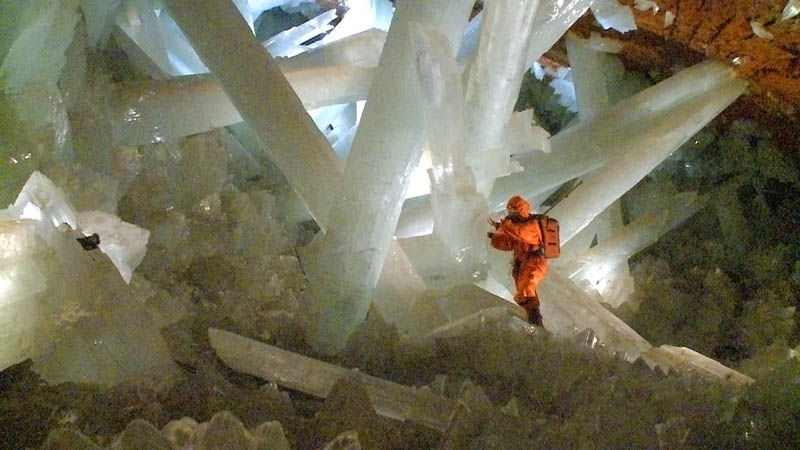
Maybe a giant burning pit belching out noxious fumes isn’t quite what you are looking for. Fair enough. How about crystals? How about the largest crystals in the world? The Crystal Cave of Giants was discovered completely by accident by a mining operation, and the determined can make the trek to nearly a thousand feet into the underworld to see these magnificent Gypsum crystals. A word of caution – the cave is close to a magma chamber, which makes temperatures and humidity in the cave similar to a sauna. A person can’t be in the chamber for more than 10 minutes without suffering serious health problems. A second hazard is that the crystals are apparently razor sharp. Not for the clumsy.


[Source: www.stormchaser.ca]

What’s that? Spelunking a thousand feet down to sit in a steam bath of knives isn’t your thing either? Why the hell not? Okay fine. What about S.C.U.B.A diving? In the Mediterranean? In Egypt? The sunken city of Heracleion, named after Heracles who is said to have visited the city himself, predates the lost city of Alexandria and is actually not that far off from it either. Unlike Alexandria, however, Heracleion survived well into the 8th century C.E before suffering a similar fate to its neighbour. The gentle embrace of the sea has preserved much of the city perfectly, and as a result is probably one of the greatest swims on the planet.


[Source: www.eqtrip.com]

Another alternative adventure lifted right from a movie can be found in comfortable and cosmopolitan Paris. Alongside the Louvre, Eiffel Tower and the Bastille, any visit to the great city should include a visit to its catacombs. You see, by the end of the 18th century, Paris was out of room to bury its dead. Cemeteries were full; some being expanded into mass graves and the juices from the decomposing bodies was entering the groundwater and leading to outbreaks of all sorts of horrible diseases. Moreover, centuries of mining limestone to build the city from underneath the city resulted in a veritable ant-hill of underground passageways, some of which were caving in under the stress of buildings and mass graves. The solution was obvious – turn these catacombs into an underground open crypt using the piles and piles of bones they had, and then sell people tickets to see them! The catacombs opened for public viewing in 1874, and has been a hit destination for goths and metal heads ever since.


For more information on these and other real life dungeons, ancient ruins and adventures, check out the map below.


Saturday, 24 January 2015

"Erik the Conquerer" pillages your intelligence and sense of reason


Only slightly more historically accurate than 300, Mario Bava’s “Erik the Conqueror” (1961) is a must see for B-movie fanatics. The completely fictional account of two brothers, Erik (played by George Ardisson) and Eron (Cameron Mitchell) separated at birth and re-united on the battlefield.

“Erik the Conqueror”, or at least that’s its Americano name – the film was also released under the names “Fury of the Vikings”, “The Invaders” or “Gli Invasori” in the original Italian – is a part of the 1960s Italian film tradition that helped make many actors such as Clint Eastwood famous. The “spaghetti western” era of Italian film was predated by the “Peplum” era, or perhaps better known as the “sword and sandal epic” – Italian medieval, fantasy and biblical themed films. Wikipedia lists this as the best Viking film made in Italy, and yes, there are more than one.

The film is an entertaining hybrid of a convincing and well thought out plot coupled with a hilarious chain of historical inaccuracies, completely over the top acting and logical fallacies. While the story, which begins with an attempt to make peace between the Vikings – yes, they are just called Vikings in this. In fact, the Vikings at one point make an alliance with Sweden, Iceland and Norway which would suggest that they are Danes – but the would-be peace treaty is disrupted by the treacherous Sir Rutford (Andrea Checchi), who kills the Viking King Harald (Folco Lulli) and the English King Lotar (Franco Russel.) The English Queen Alice (Françoise Cristophe) finds the child Erik and raises him as her own. Eron is raised back in Denmark (Vikingland?) where he eventually becomes king and leads a new invasion upon England.

While the story has some entertaining twists and turns, the real gem of this film is the completely inaccurate clothing and sets and the hilarious attempt at re-creating Viking culture. An odd assortment of improvised costumes consisting mainly of re-used props from other films – according to www.vikingsofbjiornstad.com, there’s even some clothing from the original Jason and the Argonauts in it – make the Vikings look more like some sort of medieval Mad Max gang with a harem – known as the “Vestal Virgins” (played by twin sisters Alice and Ellen Kessler). At one point, we are treated to a Viking election – one hundred “soldiers” vote by throwing axes at totem poles – yes, I said totem poles - an effect achieved by pulling the axes out of the totem poles and then running the film backwards, which looks completely obvious. The soldiers come to a tie vote on who shall lead the new conquest, so King Olaf (Jacques Delbò) declares democracy dead and instructs the two contenders, Eron and Garian, King of Sweden (Joe Robinson) to each immediately forge a weapon and fight to the death. The film is full of such hilarious nonsensical treats. At one point our hero Erik scales a castle by using arrows shot into the solid rock wall… in full plate armour. At another point, Erik is knocked off his ship in his armour and washes ashore in Vikingland, even while the film itself points out the implausibility of this by having another character on the boat strap balloons to himself to prevent from drowning.

As a cheesy backdrop for your next party or if you’re *really* bored, Erik the Conqueror is an excellent method of killing 90 minutes. If you’re not convinced yet, watch this clipping from the film showcasing “Viking Democracy.”


Tuesday, 25 November 2014

Hyperthinking: a different way to think


Philip Weiss at MacEwan University.


What allowed Google to come out of nowhere and become one of the biggest companies in the world? 
 
According to Philip Weiss, chief hyperthinker of ZN Consulting, hyperthinking is to thank.
Weiss conducted a lecture on Nov. 20 as part of Corus Entertainment’s Distinguished Lecturer series. He spoke to a crowd of over 200 students, faculty and entrepreneurs at the Kule Lecture Hall at the City Centre Campus.
  
“Hyperthinking” is Weiss’s term for the new way people need to approach problems and business models. He points out that the traditional education system does not prepare students to work with new social media realities and internet communications, which are revolutionizing society.
 
“What we’re experiencing today is an increasing number of black swans,” he explains. ”Let’s look at the Arab Spring – right until it happened, people had no clue this would happen. They didn’t know it was even possible. Lots of experts in Washington and Europe, all over the world, they didn’t predict this. Because we don’t understand the new rules of the game.”
 
To begin the lecture, Weiss showed the crowd the introduction to the Kony 2012 video, released by the organization Invisible Children. Following the video, he points out the ability of viral phenomena to come out of nowhere. He suggests that this is because people do not inherently trust governments or institutions, but they do trust other people. They presume people would be willing to tell the truth.
 
“There’s two sides to this,” he points out, referencing the H1N1 vaccine scare. “On the web, scary stories spread like wildfire.”
 
Hyperthinking, Weiss explains, is a set of skills to allow a person to navigate and thrive in this new information maelstrom.
 
Hyperthinking consists of four parts – hypershifting, hyperlearning, hyperlinking and hyperacting.
Hypershifting looks at changing our reality tunnel. Everyone has a different way of looking at the world and to be able to understand problems and communicate with vast audiences through the internet. We need to be able to shift our worldview into another person’s perspective. This can help avoid pitfalls like accidentally offending someone.
 
Hyperlearning argues that to function in the information age we need to be able to teach ourselves, because “we cannot depend on education to keep up.”
 
Weiss suggests a daily regimen of at least 10 minutes devoted to learning something new a day. He also stresses creativity and argues that it can be developed by drawing up mind maps and using “thinking hats.”
 
He also suggests taking free online classes through institutions like MIT to continue polishing your skill set.
 
Hyperlinking is the concept of using your digital networks. Weiss pointed out that today we are connected to people all around the world. These people can be useful sources of information, fact checking or possibly even work. 
 
Lastly, hyperacting is the actual process of putting your idea into practice through trial and error. Weiss emphasises that ideas need to be adaptable and that mistakes have to be made.
 
“The internet is now the ultimate source of power. It’s not just the post to overthrow governments; it’s the power to shape perception, because if you can change perception, you can change behaviour. If you change behaviour, you change the world. This is the new world we live in, and it’s changing everything.”

Sunday, 23 November 2014

Rosetta: most badass thing to happen since the moon landing

For the griff

Someday, we will all look back to these past few weeks and say, “I was there.”
 
A few of us will actually be telling the truth. The rest will only wish they had been paying attention to what, simply put, is the most bad-ass and amazing thing our collective species has achieved since Neil Armstrong stepped foot on the moon.
 
I’m talking about the Rosetta mission, the greatest mission most of you had not heard about until last week, when it launched a lander called Philae that  managed to survive a landing on the surface of the comet Churyumov–Gerasimenko. The comet is orbiting the sun at an average speed of 135,000 kilometres per hour. 
 
At that speed,  the comet could circle the Earth three times in one hour. 
 
Philae survived its landing and was able to conduct almost all of its scientific experiments in spite of having several of its landing systems fail, and bouncing off the surface of the comet up over one kilometre into the sky, only to land again and bounce a second time and land on the side of a cliff.
It powered down because it was unable to get enough sunlight to recharge its batteries – the comet itself is as black as coal.
 
When Churyumov-Gerasimenko makes its turn around the sun, the lander may in fact get a second burst of energy, resulting in more delicious, juicy science. According to the European Space Agency, we already know that the very thin atmosphere surrounding the nucleus of the comet contains organic compounds, which could mean anything from methane gas to amino acids: the building blocks of the proteins we are made of. 
 
This may strengthen the theory that the building blocks for life came from somewhere other than Earth.
 
This is the latest feat in a long history of historic firsts in space exploration that has marked the Rosetta mission. This is a good ship. The Rosetta is built with ten rockets: six for propulsion and four to slow down, and was clocked by the ESA at 48,024 km/h at one point. 
 
To reach Churyumov-Gerasimenko is to cover a mind-blowing distance of over 6.4 billion kilometres over almost 10 years. I’m not even going to attempt to come up with a metaphor for that. Let’s just say it’s a bloody long drive. 
 
To achieve this, the Rosetta combined its six rocket thrusters with a classic trick of the space robot trade, known as the slingshot effect – made famous by saving the Apollo 13 mission. The slingshot effect is buzzing close to a large body and using its gravitational pull to throw oneself out of orbit. Chances are in the future we will be using this as the main means to get around the solar system.
Rosetta did this not once, not twice, but seven times.
 
Three times with large asteroids, three times around the earth, during one of which a group of primitive hominids mistook the ship for a meteor in danger of striking the Earth maneuver and a kobayashi-maru around Mars where Rosetta was unable to use its solar panels to power its internal systems while it was in a very low orbit. 
 
In the end, Rosetta had to power itself  using the lander’s battery, something it was not supposed to be able to do, and flew blind.
 
It made it through, and even took some photos of Mars while it was at it.
 
Rosetta is a beast.
 
Not only that, but according to the ESA, the payoff for the $1.8 billion mission is huge. Rosetta has employed over 2,000 people in 10 years. Not a huge number until you remember these are 2,000 engineers. Now that’s economic growth.
 
We should also consider Rosetta’s solar panels. New ESA solar panel technology, called Low-intensity Low Temperature Cells, enabled Rosetta to be the first spacecraft to travel past the asteroid belt using solar power alone. 
 
This thing is several hundred million miles away from the sun, and it’s drawing a charge off its light. Imagine what that could do on Earth?
 
Hell, if we can keep building hardcore spacecraft like this, it won’t be much longer until we’re walking on Mars.

Monday, 17 November 2014

Timbersports: Log rolling and axe throwing

For the griff

Are you growing bored with those ho-hum extreme sports where the worst thing you can do to yourself is a sprained ankle or a concussion? Does the idea of running up a steep log at top speed with a modified chainsaw excite you? Have you had “The Log Driver’s Waltz” stuck in your head your entire maddening life? Well, your chance has finally come.
 
Katherine Spencer is bringing timbersports back to Alberta.
 
The 5’4,”115-pound Fort Saskatchewan resident has been practicing timbersports for over 10 years. She first got into timbersports while attending the University of New Brunswick, when she joined her local team.
 
She was hooked.
 
“I love it. It’s my passion,” she says.
 
Timbersports is the name given to a series of sport competitions based on traditional logging work and activities.
 
Competitive events include the standing log chop (chopping a block of wood that is standing up straight), underhand chopping (chopping a block of wood while standing on it by swinging an axe between the legs — while wearing chainmail), obstacle poll bucking (running up a log with a chainsaw, cutting a piece of said log off with the chainsaw, then running back down the log and touching the spot you just cut), as well as the self-explanatory log rolling and axe throwing.
 
Yes, axe throwing. Spencer actually has a side business teaching axe throwing. For $60 a head your group can learn how to throw an axe at a target over 20 feet away. It’s quite easy, or so she says.
While Alberta used to have a number of timbersports competitions, including the “King of the Klondike” held during Klondike Days, they had all died out by the time Spencer first moved to Alberta. The nearest competition was almost 10 hours away. Her average trip was a 13-16 hour drive each way.
 
“I got tired of my butt hurting,” she jokes, “and spending so much on gas.”
 
So in 2014, she organized the STIHL Western Canadian Qualifier, where she literally did everything.
“I did everything from porta-potties to cutting and selecting every single piece of wood,” she explains.
 
“When you’re looking at bringing back a sport into a community where it’s died out, you have to start from square one.”
 
As you can imagine, not a lot of lumberjacking happens in the cold dark winter months of Alberta. So during the off-season, Spencer chiefly does cardio.
 
“Timbersports are about 20 to 30 seconds of everything you’ve got.”
 
One good thing about the sport is that age is not a big factor in competitiveness. Unlike sports like hockey or football, timbersports are often dominated by men in their 40s.
 
“This is a sport that anybody can get involved in. There’s an event for everybody — there’s strength events, there’s endurance events, there’s finesse events.”
 
Spencer hopes to get a hold of some training logs so she can add log rolling lessons to her axe throwing business.
 
You know you want to learn how to log roll and throw axes. Don’t try to deny it.
 
If you want to contact Spencer about timbersports or axe throwing lessons, you can email her at katherine.j.spencer@gmail.com.

Tuesday, 4 November 2014

The improvised world of Viking lore

For the griff

Fjellsa Malm glares angrily at her ex-husband, Olaf Abread, from across the stage.
 
“You look dirty,” she snarls through her teeth.
 
Olaf looks back at her and rolls his eyes, barely visible above his massive, greyish beard.
 
“You are dirty,” he barks back.
 
The crowd erupts in howls of laughter. Fjellsa (played by Sheri Somerville) winces back, and then raises her sword at him. 
 
“I will castrate you.”
 
Olaf (Donovan Workun) snorts. “You did.”
 
The lights drop, the crowd erupts in laughter again, and Die-Nasty’s 24th season is underway.
 
Die-Nasty! is a live improvised soap opera operating out of the New Varscona theatre, playing every Monday at 7:30 p.m. from Oct. 20 to June 1, 2015.
 
“What makes Die-Nasty a little bit different from other improv shows is we’re long-form improv –— in that we start the season and continue the storyline with the same characters until the end of May,” explains Davina Stewart, who plays Ruvita Neddrickson in the show.
 
“For a season, we pick a genre, like the Vikings. [In the past] we’ve done Tennessee Williams, Medieval England, 1920s gangsters, the Old West, a 1970s hockey team called the Die-Hards. We did a bike gang roaming across North America.”
 
The show differs from your standard improv show in that most improv shows rely on audience participation, either a word or series of words to put together a base to work with. 
 
Using the theme and a base set of characters, Die-Nasty takes things in a totally different direction, completing a compelling episode in the lives and deaths of characters completely on the fly.
The results are an absolute riot.
 
From Fartsak Meatballs (Dana Anderson) and his deep Newfoundlander accent to Bjorn Wulfgarrson (Matt Alden) combining the fine arts of wordsmithing, river dancing, sword fighting and talking like Luigi from Super Mario Bros., there wasn’t a moment where I was not in pain from laughing so hard.
“It’s a lot of fun. Storylines continue through episodes, but people shouldn’t feel that they’ll be lost if they haven’t seen all the episodes coming up,” says Paul Morgan Donald, who produces the music for the show — in this case as a Viking playing a mandolin in the background. 
 
“We always make clear what the story situations are so it’s easy to jump right in and get caught up on what’s happening.”
 
The beauty of improv is the fact it can go just about anywhere. At one point, we were witnesses to a debate between Neddrick the Plate (Jeff Haslam) and his wife Jysk (Stephanie Wolfe) over whether they should be teaching their children about the gods. Neddrick, you see, is an atheist and is worried that introducing his kids to the ways of Thor, Odin, Loki and the nefarious Parsnip could harm them in the long run.
 
By the end of the show, we have learned of the Norse gods Parsnip, Dopey, Sleepy and Happy.
The brilliant madness of this seems to have no end.
 
“I wonder how many gods will be in the Norse pantheon in a few months?” asks Jarl Wulfgar Stormbringer (Mark Meer) aloud to his wife, Freya Thordottir (Shannon Blanchet) as the first act comes to a close.
Good question, Wulfgar. We can’t wait to find out.